
A 5kVA diesel generator is a practical backup power option for homes, small businesses, shops, and light-duty equipment. Its compact design makes it easier to transport and install than larger industrial generator sets, while a suitable enclosure can help reduce operating noise.
A 5kVA generator provides 5kVA of apparent power, but its actual output in kilowatts depends on its rated power factor and the manufacturer's specifications. For example, 5kVA at a power factor of 0.8 equals 4kW. Some single-phase portable generator models are rated differently, so buyers should always check the rated kW and maximum kW rather than relying on the kVA figure alone.
At WALT POWER, we regularly deal with questions about generator sizing, fuel consumption, voltage, starting current, automatic operation, and maintenance. This guide answers 20 common questions to help buyers select and operate a 5kVA diesel generator more confidently.

Type of 5kVA Diesel Generator
Small air-cooled diesel generator sets are generally available in two configurations: silent and open-frame.
Silent diesel generators have an acoustic enclosure designed to reduce operating noise. The enclosure also provides a degree of protection against outdoor conditions, although its suitability for outdoor installation depends on the enclosure design and environmental protection rating.
Open-frame diesel generators do not have a full acoustic enclosure. They are generally easier to access for maintenance, but their operating noise is more noticeable. They must be installed in a suitable protected location.
For both types, proper ventilation and exhaust discharge are essential. A diesel generator must never be operated inside a house, garage, basement, or other enclosed occupied space.
If the generator will remain unused for an extended period, store it in a dry, ventilated location and follow the manufacturer's storage instructions.
Standard Voltage and Frequency of 5KVA Diesel Generator
5kVA diesel generators can be configured for different voltage and frequency requirements, depending on the alternator, engine speed, and electrical design.
Common configurations include:

| Configuration | Common Voltage Options |
|---|---|
| Single-phase, 50Hz | 220V, 230V, 240V |
| Single-phase, 60Hz | 110V, 115V, 120V, 220V, 230V |
| Three-phase, 50Hz | 380V, 400V, 415V |
| Three-phase, 60Hz | 220V, 230V, 440V, 460V, 480V |
| Special dual-voltage configurations | 110/220V 50Hz, 120/240V 60Hz, subject to model availability |
These are possible generator configurations, not a guarantee that every 5kVA model supports every voltage.
Before ordering, confirm the required voltage, frequency, phase arrangement, and whether the generator must supply both 120V and 240V loads.
For three-phase models, the total output capacity is shared across the phases. Unevenly distributed single-phase loads can create phase imbalance and must remain within the alternator manufacturer's limits.
5kVA Diesel Generator Technical Specifications: Quick Reference
The following information provides a practical reference for selecting a small diesel generator. Model-specific values must be checked against the relevant specification sheet.
| Item | Reference Information |
|---|---|
| Generator category | Small air-cooled diesel generator |
| Output rating | Check both rated kW and maximum kW |
| Frequency | 50Hz or 60Hz, depending on model |
| Engine speed | Commonly 3000 rpm at 50Hz or 3600 rpm at 60Hz for two-pole sets |
| Starting options | Manual recoil or electric start, depending on configuration |
| Automatic operation | Available on compatible electric-start models with suitable ATS and control interfaces |
| WDG-7800DSE fuel tank | 15 liters |
| WDG-7800DSE stated running time | 8.5 hours under the specified operating condition |
| WDG-7800DSE engine oil capacity | 1.65 liters |
| Fuel consumption | Depends on model, electrical load, and operating conditions |
The following questions explain these specifications and the practical issues that buyers should consider.
Q1. What will a 5kVA diesel generator run?
A 5kVA diesel generator can supply many common household and small commercial electrical loads, provided their combined running demand and starting requirements remain within the generator's capacity.
Typical applications include:
- Refrigerators and freezers
- Lighting and televisions
- Computers, routers, and office equipment
- Small pumps
- Selected power tools
- Small air conditioners
- Essential electrical equipment in shops or small offices
However, not all of these appliances can necessarily operate at the same time.
The most important consideration is the difference between running power and starting power.
Equipment with electric motors, such as pumps, compressors, and conventional air conditioners, may require substantially more power during startup than during normal operation.
I recommend checking the actual electrical nameplate of each major appliance before deciding whether a 5kVA generator is sufficient.

Q2. Can a 5kVA generator power a house?
Yes. A 5kVA diesel generator can provide emergency backup power for a house, particularly when the owner prioritizes essential appliances rather than attempting to operate the entire household simultaneously.
For example, it may be suitable for lighting, refrigeration, communications equipment, and selected smaller appliances.
However, a 5kVA generator may not be sufficient for a house with multiple air conditioners, electric water heaters, electric cooking appliances, or other high-power equipment operating together.
The correct generator size depends on:
- The total running load.
- The largest motor starting requirement.
- Which appliances must operate simultaneously.
- The generator's rated continuous output.
- Any expected future load expansion.
For household backup power, a qualified electrician should also verify the transfer arrangement, grounding, and local electrical code requirements.
Q3. What is the power output of a 5kVA generator?
The output of a generator must be understood in terms of both kVA (apparent power) and kW (active power).
The relationship is:
kW = kVA × Power Factor
For example:
| Generator Rating | Power Factor | Active Power |
|---|---|---|
| 5kVA | 0.8 | 4kW |
| 5kVA | 1.0 | 5kW |
For WALT POWER's small portable diesel generator range, the WDG-6800 and WDG-7800 series have different rated and maximum outputs depending on their exact model configurations.
A generator's maximum output is intended for limited-duration loading under the manufacturer's conditions. It should not be treated as its continuous operating capacity.
When comparing quotations, I suggest requesting both the rated output and maximum output in kW, together with the specified power factor.
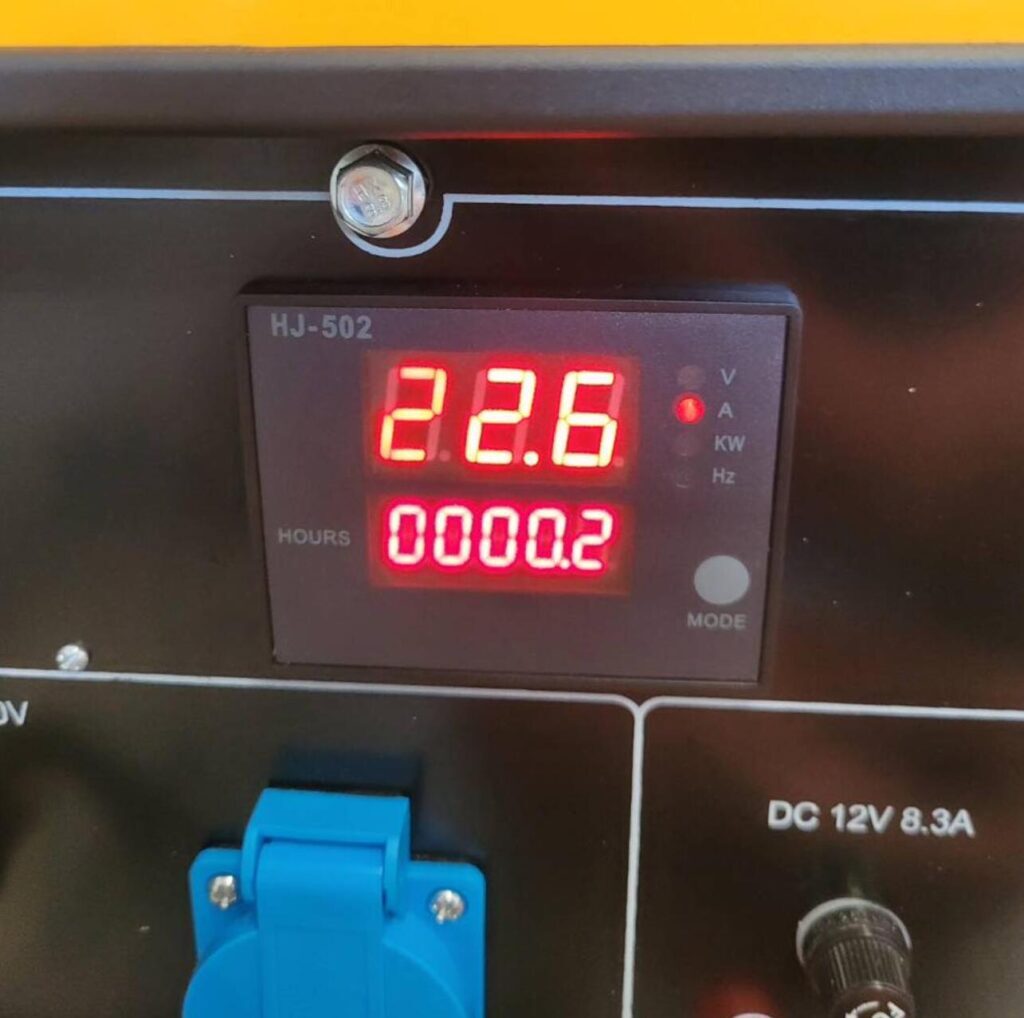
Q4. How many amps does a 5kVA diesel generator produce?
The current depends on whether the generator is single-phase or three-phase, its output voltage, and its actual rated kVA.
For a single-phase generator:
Current (A) = kVA × 1000 ÷ Voltage (V)
For a balanced three-phase generator:
Line Current (A) = kVA × 1000 ÷ (√3 × Line Voltage)
The following tables show calculated current values for a 5kVA output.
Single-phase, 50Hz
| Voltage | Current at 5kVA |
|---|---|
| 220V | 22.7A |
| 230V | 21.7A |
| 240V | 20.8A |
Three-phase, 50Hz
| Line Voltage | Line Current at 5kVA |
|---|---|
| 380V | 7.6A |
| 400V | 7.2A |
| 415V | 7.0A |
Single-phase, 60Hz
| Voltage | Current at 5kVA |
|---|---|
| 110V | 45.5A |
| 120V | 41.7A |
| 220V | 22.7A |
Three-phase, 60Hz
| Line Voltage | Line Current at 5kVA |
|---|---|
| 220V | 13.1A |
| 440V | 6.6A |
| 460V | 6.3A |
Important: These are theoretical calculations based on 5kVA, not the nameplate currents of every WALT POWER model.
The generator's actual rated output, circuit breaker, receptacle ratings, wiring configuration, and allowable phase imbalance must also be considered.
For example, a 5kVA three-phase generator does not provide 5kVA independently on each phase.
Q5. How much horsepower (hp) does a 5kVA diesel generator have?
A 5kVA generator does not have one universal horsepower rating.
Horsepower describes the engine's mechanical output, while kVA describes the generator's electrical apparent power.
The engine must provide enough mechanical power to drive the alternator while accounting for alternator efficiency and operating conditions.
The conversion between mechanical horsepower and kilowatts is approximately:
1 hp = 0.746 kW
However, directly converting a generator's electrical kVA into engine horsepower would be misleading.
For accurate engine horsepower information, refer to the engine manufacturer's rated output at the specified operating speed.
Q6. What is the rpm/speed of a 5kVA diesel generator?
Many small air-cooled diesel generators use engines operating at:
- 3000 rpm for 50Hz
- 3600 rpm for 60Hz
These speeds are commonly used with two-pole alternators.
The relationship between frequency, alternator speed, and the number of poles is:
Frequency (Hz) = RPM × Number of Poles ÷ 120
Other generator designs may operate at different speeds.
For a conventional fixed-speed diesel generator, stable engine speed is important because it directly affects output frequency.
Q7. What is the engine oil capacity of a 5kVA diesel generator?
The engine oil capacity of WALT POWER's WDG-7800DSE is 1.65 liters, according to its product specification.
This figure should not be applied automatically to other 5kVA generator models.
Oil capacity varies with the engine model and crankcase design.
When changing engine oil, use the specified oil grade and verify the correct level with the dipstick or the manufacturer's recommended checking procedure.
Do not assume that adding the full nominal capacity is always appropriate when some oil remains inside the engine.

Q8. How much does a 5kVA diesel generator weigh?
Weight varies considerably between silent and open-frame configurations.
For the models described in our original product range:
| Generator Type | Reference Weight |
|---|---|
| Silent diesel generator with electric start and battery | Approximately 152kg |
| Open-frame diesel generator with electric start and battery | Approximately 105kg |
These are model-specific reference figures, not universal weights for all 5kVA generators.
Some portable models can be equipped with wheels and handles to make movement easier.
For overseas buyers, I recommend confirming both the net weight and gross shipping weight, especially when calculating freight costs or arranging container loading.
Q9. Can a 5kVA diesel generator start and stop automatically?
Yes, but only when the generator has the necessary electric-start system, compatible control interface, and properly configured automatic transfer switch (ATS).
An ATS alone does not guarantee automatic generator operation.
A typical automatic backup sequence is:
- The ATS detects a utility power failure.
- The ATS or associated controller sends a start request.
- The generator's starting system starts the engine.
- The controller verifies that generator voltage and frequency are acceptable.
- The ATS transfers the load to generator power.
- When utility power returns and remains stable, the ATS transfers the load back.
- The generator completes its configured cooling period and stops.
The exact sequence depends on the ATS and generator control system.
Before purchasing, confirm that the generator supports remote automatic starting and that the ATS is electrically compatible with its controller.

For additional troubleshooting guidance, see Why Does My Generator Start Manually but Not Automatically?.
Q10. What are the dimensions of a 5kVA diesel generator?
The dimensions depend on the enclosure and generator configuration.
The reference dimensions from our original product range are:
| Generator Type | Dimensions (L × W × H) |
|---|---|
| Silent diesel generator | 920 × 530 × 680mm |
| Open-frame diesel generator | 705 × 490 × 590mm |
These dimensions refer to the generator itself and may not include export packaging.
When purchasing generators for overseas distribution, buyers should request the packed dimensions and gross weight separately.
Q11. How long can a 5kVA diesel generator run continuously?
The running time depends on the fuel tank capacity, electrical load, and engine fuel consumption.
For example, WALT POWER's WDG-7800DSE has a 15-liter fuel tank and a stated running time of 8.5 hours under the operating conditions specified for that model.
This does not mean every 5kVA generator can run for 8.5 hours on a full tank.
A generator operating at a lighter load may consume less fuel per hour, although the relationship is not perfectly proportional.
Fuel tank endurance should also be distinguished from the maximum recommended continuous operating period.
Longer operation requires proper attention to engine temperature, oil level, ventilation, fuel supply, and the manufacturer's servicing instructions.
Q12. How much fuel does a 5kVA generator use per hour?
A 5kVA diesel generator's fuel consumption depends on its actual electrical load and engine characteristics.
For the WALT POWER WDG-7800DSE, the product specification gives a 15-liter fuel tank and a stated running time of 8.5 hours.
Using these figures:
Average fuel consumption = 15L ÷ 8.5h ≈ 1.76L/h
Therefore, the calculated average fuel consumption over that stated operating period is approximately 1.76 liters per hour.
This is a model-specific calculation, not a universal fuel consumption rating for all 5kVA diesel generators.
It should also not be interpreted as a verified full-load consumption figure unless the specified 8.5-hour operating condition is confirmed as full load.
In practice, fuel consumption changes with:
- Actual electrical load in kW
- Engine efficiency and operating speed
- Generator configuration
- Maintenance condition
- Ambient temperature and altitude
When comparing generators, I recommend requesting fuel consumption at several defined load points, such as 50%, 75%, and 100% of rated output, where manufacturer data is available.
This gives a more useful basis for estimating operating costs than comparing tank capacity alone.
Q13. Can a 5kVA generator power a fridge?
Yes. A properly sized 5kVA diesel generator can usually power a household refrigerator, provided its starting demand and the other connected loads remain within the generator's capacity.

Refrigerators generally require more electrical power when their compressors start than during normal operation.
For example, the following ranges illustrate how starting requirements can vary:
| Refrigerator Category | Illustrative Running Power | Illustrative Starting Power |
|---|---|---|
| Small refrigerator | 50–150W | 200–500W |
| Medium refrigerator | 200–400W | 600–1200W |
| Large refrigerator | 500–1000W | 1500–4000W |
These are broad examples rather than guaranteed specifications. Actual values depend on the compressor and appliance design.
Some inverter refrigerators have different starting characteristics from conventional fixed-speed compressor models.
A generator equipped with an automatic voltage regulator (AVR) can help regulate output voltage, but the AVR does not eliminate the need to check compressor starting current.
For sensitive electronic appliances, voltage and frequency stability should also be considered.
Q14. Can a 5kVA generator power an air conditioner?
Yes, a 5kVA generator can power certain small air conditioners, but suitability depends on the air conditioner's actual electrical input and compressor starting characteristics.
Cooling capacity, usually expressed in BTU/h, is not the same as electrical power consumption.
The following figures are illustrative electrical input ranges for selected air conditioner categories. They should not be treated as universal ratings.
| Air Conditioner | Illustrative Running Input |
|---|---|
| 5,000 BTU/h window AC | Around 0.9kW |
| 6,000 BTU/h window AC | Around 1.1kW |
| 8,000 BTU/h window AC | Around 1.2–1.5kW |
| 10,000 BTU/h window AC | Around 1.4–1.8kW |
| 12,000 BTU/h window AC | Around 1.6–2.0kW |
| 8,000 BTU/h portable AC | Around 1.0kW |
| 10,000 BTU/h portable AC | Around 1.2kW |
| 12,000 BTU/h portable AC | Around 1.5kW |
| 14,000 BTU/h portable AC | Around 1.8kW |
Actual input power may differ significantly, particularly for modern inverter air conditioners.
The main concern is often compressor starting demand rather than normal running consumption.
A conventional compressor can produce a substantial temporary current increase when starting. An inverter-driven compressor may start more gradually, depending on its design.
Before selecting a generator, check the air conditioner's rated input, maximum input, and starting current or locked-rotor current where applicable.
If the air conditioner must operate together with refrigerators, pumps, or other motor loads, their combined starting conditions should also be evaluated.
Q15. Do diesel generators run longer than gas or petrol generators?
Diesel generators can offer advantages in fuel efficiency and durability, but actual runtime depends on the specific equipment.
Three important considerations are:
Fuel efficiency: Diesel engines often have favorable fuel efficiency characteristics, particularly under suitable operating loads. However, generator-to-generator comparisons should use actual fuel consumption data.
Fuel storage: Diesel fuel has different handling and volatility characteristics from gasoline. Safe storage, fuel cleanliness, and local regulations remain important.
Engine durability: Diesel engines are commonly selected for commercial and industrial applications, but service life depends heavily on engine design, loading, maintenance, and operating conditions.
A diesel generator does not automatically run longer simply because it uses diesel fuel.
To compare runtime fairly, consider the usable fuel capacity and fuel consumption at the same electrical output.
Q16. How far should a diesel generator be from the house?
A diesel generator must be operated outdoors, away from doors, windows, ventilation openings, and occupied spaces.
Carbon monoxide in engine exhaust can be fatal, even when the generator is operating normally.
The required clearance depends on the generator manufacturer's instructions, local regulations, exhaust direction, and surrounding building conditions.
Some portable generator safety guidance recommends a separation of at least 20 feet (approximately 6 meters) from occupied buildings, with the exhaust directed away from openings. This should not be treated as a universal installation rule for every generator.
Never operate a diesel generator inside a house, garage, basement, or partially enclosed area, even with doors or windows open.
For permanent installations, a qualified installer should assess exhaust discharge, cooling airflow, fire safety, noise, weather protection, and electrical connections.
Q17. What is the maintenance schedule for a 5kVA diesel generator?
Regular maintenance is essential for reliable generator operation, especially when the unit is used as emergency backup equipment.
Maintenance intervals vary according to the engine model and operating environment.
The following checklist identifies common maintenance activities. It is not a substitute for the maintenance schedule supplied with the actual engine.
| Maintenance Item | Recommended Approach |
|---|---|
| Check engine oil level | Before operation or according to the engine manual |
| Check fuel level and fuel condition | Before operation |
| Inspect for oil and fuel leaks | Before operation |
| Check air intake and ventilation openings | Before operation |
| Inspect battery and terminals | Periodically, especially before standby operation |
| Change engine oil | At the specified initial and subsequent service intervals |
| Inspect or replace air filter | According to operating conditions and engine instructions |
| Inspect fuel filter | According to the engine maintenance schedule |
| Check fasteners and mounting components | Periodically |
| Inspect electrical connections | During scheduled maintenance by qualified personnel |
| Inspect fuel hoses | Periodically and replace when damaged or deteriorated |
| Check valve clearance | Only at the engine manufacturer's specified interval |
| Inspect injection equipment | When required by the service schedule or fault symptoms |
| Test generator output | During scheduled operational checks |
| Check insulation condition | As appropriate, particularly after prolonged storage |
Some small diesel engines require an early first oil change after the initial running period. Later oil change intervals may differ substantially between engine models.
Operations such as injector servicing, cylinder-head tightening, valve grinding, or piston-ring replacement should not be presented as routine annual maintenance unless specifically required by the engine manufacturer.
For standby generators, I also recommend periodic test operation under a suitable electrical load rather than starting the engine briefly without checking whether the generator can actually supply power.
Q18. What are the recommended running hours of a generator before service?
There is no single service interval that applies to every 5kVA diesel generator.
Some engines require their first oil change relatively early, while subsequent service intervals depend on the engine design and operating conditions.
For certain small diesel engines, routine servicing may be specified at intervals such as 100 or 250 operating hours, but these figures should not be assumed for all models.
The correct approach is to follow the engine manufacturer's maintenance schedule and consider:
- Total operating hours
- Time elapsed since the previous service
- Ambient dust and temperature
- Operating load
- Fuel and lubricant quality
- Storage conditions
For a generator used only occasionally, calendar-based maintenance remains important even if operating hours are low.
Q19. If a 5kVA diesel generator has not been used for a long time, how should it be operated before starting again?
A generator that has been stored for several months should be inspected before restarting.

I recommend the following checks:
-
Inspect the generator visually. Look for fuel leaks, damaged wiring, loose connections, corrosion, and signs of moisture or animal intrusion.
-
Check the engine oil. Confirm that the oil level and condition are acceptable. Replace old or contaminated oil when required by the maintenance schedule.
-
Check the diesel fuel. Fuel that has been stored for a long period may become contaminated or deteriorate. Inspect and replace it when necessary.
-
Inspect the air filter and ventilation openings. Remove any obstruction before starting.
-
Check the starting battery. For electric-start models, verify battery condition, terminal connections, and adequate charge.
-
Confirm that the generator output is disconnected from the load. Follow the manufacturer's starting procedure.
-
Start the generator and observe its operation. Check for unusual noise, vibration, smoke, leaks, or warning indications.
-
Verify voltage and frequency before connecting equipment. Apply a suitable load gradually and monitor operation.
If the generator has been stored in a damp environment or shows signs of electrical deterioration, its insulation condition should be checked by qualified personnel before use.
Avoid adding lubricating oil directly into the cylinder or carrying out special decompression procedures unless they are specifically required by the engine manufacturer's storage and restart instructions.
Q20. If a 5kVA diesel generator encounters a fault, how can it be quickly troubleshooted?
When troubleshooting a diesel generator, I recommend identifying the actual symptom first.
A generator that fails to start requires a different diagnostic approach from one that starts normally but produces no electrical output.

Problem 1: The 5kVA diesel generator does not start
| Possible Cause | Recommended Check or Action |
|---|---|
| Insufficient diesel fuel | Check fuel level and fuel supply |
| Fuel valve closed | Confirm the valve is in the correct operating position |
| Weak or discharged starting battery | Check battery voltage, terminals, and charging condition |
| Low engine oil protection activated | Check oil level and investigate the protection indication |
| Incorrect operating switch position | Follow the manufacturer's starting procedure |
| Air in the fuel system | Follow the approved fuel-system bleeding procedure if applicable |
| Blocked fuel filter | Inspect and service according to the engine manual |
| Fault in the starting circuit | Check the starter, relay, wiring, and control signals |
| Fuel injection problem | Arrange inspection by a qualified diesel technician |
If the engine cranks normally but does not start, concentrate on fuel supply, engine protection, and combustion-related conditions.
If the engine does not crank at all, start with the battery, starter circuit, switches, and any active start-inhibit conditions.
Do not dismantle high-pressure diesel injection components without the necessary training and equipment.
Problem 2: The diesel generator starts but produces no voltage
| Possible Cause | Recommended Check or Action |
|---|---|
| Output circuit breaker is open or tripped | Check the breaker and investigate the cause before resetting |
| Loose or damaged output connection | Inspect the connection with the generator safely isolated |
| Engine speed is incorrect | Check output frequency and engine speed |
| AVR or excitation system fault | Have the excitation system tested by qualified personnel |
| Worn brushes, if fitted | Inspect and replace according to the alternator design |
| Alternator winding or internal fault | Arrange appropriate electrical testing |
| Incorrect voltage selection or wiring configuration | Verify the specified output configuration |
Not all alternators use brushes, and not every no-voltage problem is caused by the AVR.
The diagnostic sequence should begin with the output breaker and measured voltage, then proceed to engine speed, excitation, and alternator components as necessary.
Problem 3: The generator produces black smoke or struggles under load
Black exhaust smoke may indicate excessive fueling relative to available combustion air, overloading, restricted air intake, or an engine-related fault.
Reduce or disconnect the load safely and investigate the cause.
Do not continue operating the generator under severe overload or abnormal engine conditions.
Conclusion
A 5kVA diesel generator can be a practical solution for residential backup power, small businesses, and light-duty applications. However, choosing the correct generator requires more than comparing the advertised kVA rating.
I recommend checking the rated kW output, voltage and frequency, motor starting requirements, fuel consumption, automatic-start compatibility, and maintenance requirements before making a purchase.
For overseas importers and distributors, consistency between the technical specification, actual equipment configuration, and shipping documents is equally important.
At WALT POWER, we supply portable air-cooled diesel generators in different configurations for international markets. Buyers can review our portable silent diesel generator range or contact WALT POWER to discuss their required voltage, frequency, quantity, and application.
The right generator is not simply the one with the highest advertised maximum output. It is the one that can reliably supply the intended load under the actual operating conditions.


